
join the revolution. upend the oppression of capital

marxist, feminist, urbanist, technologist, musician, and free-culture/free software advocate.

Chairman Fred

  • 0 Posts
  • 16 Comments
Joined 10 months ago
cake
Cake day: January 30th, 2026

help-circle
  • “The study doesn’t show it removes the ability to do hard things” Again, who exactly are you arguing against? Nobody said this… Neither the press release nor I

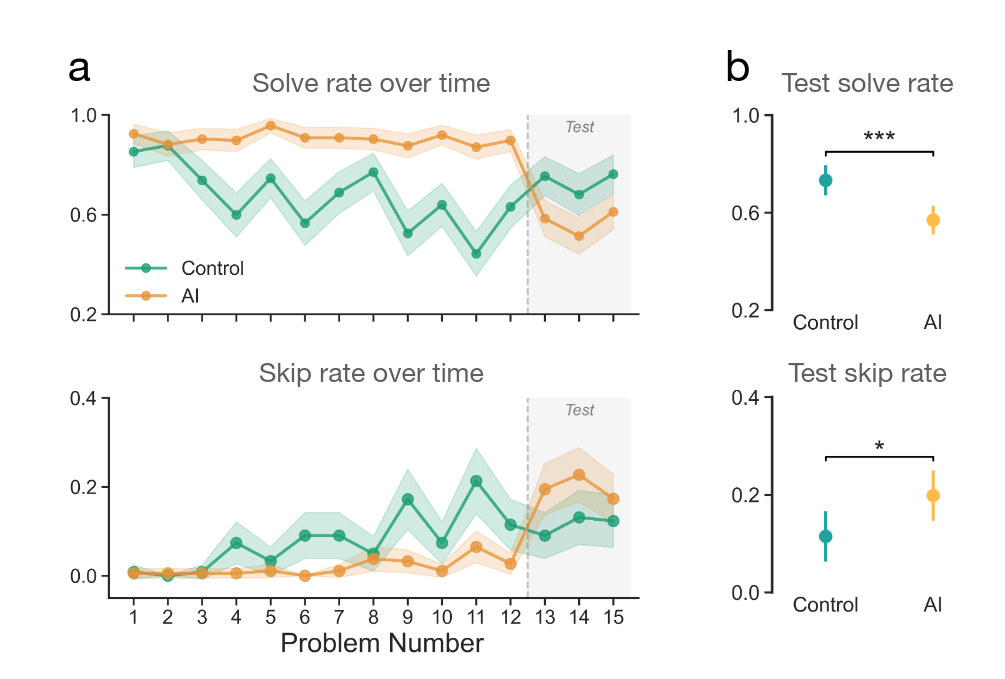
    “People who used AI for ten minutes before performing difficult tasks actually performed better than those who did not.” I’d gently encourage a quick re-read of the paper, as the statistic results directly contradict your claim. Here’s experiment 1 (fraction math problems):
    image

    The solve rate measures the rate at which the participants correctly solved the problem, and the skip rate measures the rate at which the participants chose to skip the problem rather than inputting an answer. We observe that with AI assistance (i.e., the first 12 problems), participants in the AI condition were significantly more likely to solve problems correctly and less likely to give up compared to the control participants. However, when the AI was removed, their performance dropped and they were also less likely to persist with problems (as seen by the increased skip rate). Here’s experiment 2 (same fraction problems, but with an added pretest): image Finally, experiment 3 (SAT-style reading comprehension): image To clarify, people who used AI did worse than the people who never used AI on the test.

    “The title heavily implies that just ten minutes of AI usage makes difficult tasks harder to perform, which is not what the study showed or concluded” and Again, just to make sure we aren’t proceeding on a misunderstanding here, the headline says “persist”, which means to refusing to give up. The definition of persist is not that of perform. Further, I suggest you re-read the research paper. The abstract directly states, “impairment of unassisted performance”

    “The conclusion the researchers drew, which is up for interpretation, was that prolonged AI usage may potentially impair people’s ability to perform harder tasks without assistance.” I think you may be confused about how experimental studies work in research. In the experiment, when they controlled the variable of AI assistance, the experimental results showed statistically significant results proving the hypothesis that test solve rate of the control group was greater than the test solve rate of the AI group.


  • Forgive me, but i’m not understanding why you find the headline to sensationalize or over state the actual findings of the study. The abstract of the paper directly says:

    we provide causal evidence for two key consequences of AI assistance: reduced persistence and impairment of unassisted performance.

    I’m struggling to discern a meaningful difference between “erodes your ability to persist at hard things” and “reduced persistence of unassisted performance”. Forgive me for not understanding but I would appreciate your explanation. The paper’s very own conclusion actually uses the term erosion:

    Here, we show that AI interaction can result in significant impairments in independent performance and persistence – capacities that are foundational to life-long learning. If brief exposure produces measurable erosion, the cumulative effects of daily AI use over months or years may be profound and difficult to reverse

    I found a definition of erosion: “the gradual loss of something as a result of an ongoing process”. Trust can erode and be rebuilt; soil can erode and be restored.

    I agree that 10 mins of foundation model assistance likely doesn’t “permanently damage your brain or destroy your ability to think for yourself”. However, in my reading of the Berkeley news piece, I find no claim of this specific kind. Does the text of the press release explicitly claim the duration of effect is long-term or lasting? Does it explicitly claim the the erosion is permanent? Again, I find myself confused what you are arguing against.





  • I don’t have any familiarity with using this kind of software, but I looked through the git repo of SavaPage. It looks like it has been actively developed for the past few years, which is a great sign, but it looks like almost all commits are done by one user. The issue tracker is also a little meager, with just one open issue, potentially pointing to a very small user base. Adoption heavily depends on as long as that one person keeps maintaining the project.


  • Honestly, you’re a few months late to the whole buying GPUs for local llms party, so expect exorbitant prices even for older cards

    The name of the game is vram. For the most part, more is better. If you can get your hands on multiple matching (same model) 24gb or higher cards (within price range), you’re golden.

    Going for more than 2 gpus can become challenging with motherboard pcie slot heights, so make sure either your cards aren’t too tall or you have widely spaced out pcie slots.

    For inference, speed (tokens/second) is limited by memory bandwidth. Go for faster bandwidth memory cards if you can afford it (e.g. GDDR6 will be faster than GDDR5).

    Also with multi gpus you will need an adequate power supply, and a large enough case.

    If you want to be a bit eccentric and load huge models, you can also go the CPU route and fill up a motherboard with 256 GB ram, because then you’re in the several hundred B param model territory, which could, depending on your use case, be better than having faster inference on smaller/quantized models. Even then, DDR5 with high MHz is still way slower than gpus.


  • Has anyone compiled a list of where projects are moving to? I know many linux desktop applications are self hosting on gitlab, but i’ve also seen gitea and codeberg. If anyone has opinions about a preference, do comment. I have been enjoying self hosting gitea for my simple personal projects and for deploying simple web apps, all on $5 vps.


  • Most arguments people make against AI are in my opinion actually arguments against capitalism. Honestly, I agree with all of them, too. Ecological impact? A result of the extractive logic of capitalism. Stagnant wages, unemployment, and economic dismay for regular working people? Gains from AI being extracted by the wealthy elite. The fear shouldn’t be in the technology itself, but in the system that puts profit at all costs over people.

    Data theft? Data should be a public good where authors are guaranteed a dignified life (decoupled from the sale of their labor).

    Enshittification, AI overview being shoved down all our throats? Tactics used to maximize profits tricking us into believing AI products are useful.